


You’ve probably noticed how the same thoughts loop back. How anxiety shows up right when you need to focus. How compulsions eat into your day, your relationships, your ability to just exist without that constant hum of dread.
Cognitive Behavioral Therapy in Arlington, TX helps you identify the distorted thinking that fuels those cycles. Then it teaches you how to challenge it, reshape it, and replace it with responses that actually serve you.
Most people see measurable progress within 12 to 20 sessions. That’s not magic—it’s structured, goal-oriented work. You’ll learn cognitive restructuring techniques that help you catch unhelpful thoughts before they spiral. You’ll practice behavioral activation to stop avoidance in its tracks. And if you’re dealing with OCD, exposure and response prevention becomes the backbone of your treatment—proven to reduce symptoms by an average of 64% when done right.
This isn’t about feeling better for a few days. It’s about building skills that last, so anxiety and OCD stop dictating how you live.
We serve Arlington, TX with a team that includes nationally recognized researchers, published clinicians, and providers who’ve personally navigated OCD and anxiety disorders. That combination matters because it means you’re working with people who understand both the clinical research and the lived reality of what you’re facing.
We specialize in CBT for anxiety and CBT for OCD using exposure-based therapies that have the strongest evidence behind them. Many of our clinicians hold credentials from the International OCD Foundation and have shaped treatment guidelines used across the country.
You can meet with us in person or through secure telehealth sessions. We work with children, teens, and adults throughout the Dallas-Fort Worth area, and we’ve built our practice around one simple idea: no one should wait 17 years to find treatment that actually works. That’s the current average, and it’s unacceptable.

Your first session is an assessment. We’ll ask about your symptoms, your history, what you’ve tried before, and what’s bringing you in now. No judgment, no pressure—just clarity on where you are and where you want to be.
From there, we build a treatment plan. If you’re dealing with generalized anxiety or social anxiety, we’ll focus on cognitive restructuring and behavioral experiments that test your fears in real situations. If it’s OCD, we move into exposure and response prevention—deliberately facing the thoughts or situations that trigger compulsions, without performing the compulsion. That’s how the anxiety loses its grip.
Sessions typically run weekly for 12 to 20 weeks, depending on your goals and the complexity of what you’re working through. Some people benefit from our intensive outpatient format, which means three hours a day of focused treatment to create faster momentum. Others do better with standard weekly sessions.
You’ll get homework. Real-life practice between sessions is where the change actually happens. We’ll guide you through it, adjust as needed, and make sure you’re never doing exposures you didn’t agree to. You set the pace. We provide the structure and expertise.

Ready to get started?
Every session is built around your specific symptoms and goals. You’ll work one-on-one with a licensed therapist trained in CBT therapy and exposure-based methods. That means you’re getting individualized attention, not a cookie-cutter protocol.
We include psychoeducation so you understand how anxiety and OCD operate in your brain. That knowledge alone can reduce some of the fear. You’ll also get tools for cognitive restructuring—learning to spot cognitive distortions like catastrophizing, black-and-white thinking, or mind reading, and then challenging those thoughts with evidence.
For OCD, exposure therapy is non-negotiable. It’s the gold standard. We’ll work with you to create a hierarchy of feared situations, then gradually work through them while preventing compulsions. Research shows that 65 to 80% of people who complete ERP see significant improvement.
If you’re in the Arlington, TX area and juggling the fast pace of life in the Dallas-Fort Worth Metroplex, we get it. Professional demands, family responsibilities, social expectations—they all add pressure. That’s why we offer flexible scheduling, telehealth options, and intensive formats for people who need faster results. We also work with most major insurance plans, and 95% of our clients access care through their benefits.
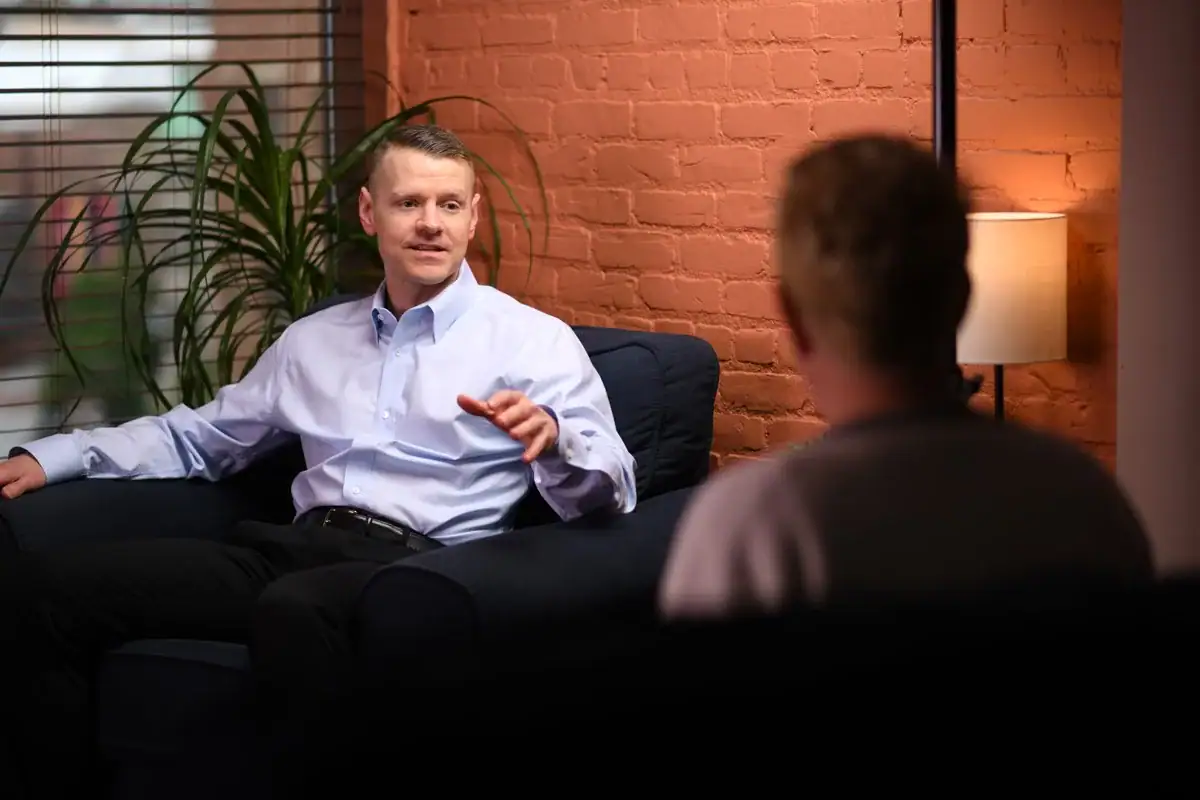
Traditional talk therapy often focuses on exploring feelings and processing experiences. That can be helpful for some issues, but it doesn’t address the mechanics of OCD. In fact, talking endlessly about obsessions can actually reinforce them.
CBT for OCD in Arlington, TX uses exposure and response prevention, which is a completely different approach. You’re not analyzing why you have the thought—you’re learning to tolerate the discomfort it causes without doing the compulsion. Over time, your brain learns that the feared outcome doesn’t happen, and the anxiety decreases naturally.
This method is backed by decades of research. Studies show response rates between 51% and 70%, and the earlier you start, the better the outcomes tend to be. If you’ve been in therapy before and didn’t see progress, it’s worth asking whether your therapist was trained in ERP specifically. Most general therapists aren’t, and that gap can cost you years.
Most people complete CBT therapy in 12 to 20 weekly sessions. Some see noticeable improvement within the first four to six weeks, especially if they’re consistent with homework and practice between sessions.
If you’re dealing with more complex symptoms—like OCD with multiple themes, or co-occurring depression and anxiety—it might take closer to 16 to 20 sessions. That’s still considered short-term therapy compared to other modalities that can stretch on indefinitely without clear endpoints.
We also offer intensive outpatient programs for people who want faster results or who’ve been stuck for a long time. These programs involve three hours of treatment per day over a condensed period, and they tend to produce an average symptom reduction of 64%. The key is that CBT has a clear structure and measurable goals, so you’re not left wondering if it’s working.
Exposure therapy sounds scarier than it is. You’re not thrown into your worst fear on day one. We start by building a hierarchy—a ranked list of situations or thoughts that trigger anxiety, from least to most distressing.
Then we work through that list gradually. If you have contamination fears, we might start with touching a doorknob and not washing your hands immediately. If it’s intrusive thoughts, we might have you write out the thought and sit with it without doing a mental ritual. The goal is to stay in the discomfort long enough for your anxiety to naturally decrease, which it will.
Sessions in Arlington, TX are done collaboratively. You decide what you’re ready for, and we guide the process. No one forces you into anything. But we will encourage you to push past avoidance, because that’s where the progress happens. Research shows that the more exposure you do, and the longer you stay in it, the better your outcomes.
Yes. In fact, about 26% of people with OCD also have a co-occurring anxiety disorder, and over 60% have a parent with a history of anxiety or related conditions. The two often overlap, and CBT techniques for anxiety can address both.
Cognitive restructuring works for generalized anxiety, social anxiety, and the distorted thinking patterns that show up in OCD. Exposure therapy is used across all anxiety-related disorders—it’s effective in about 66% of cases and takes up roughly 41% of treatment time on average.
What matters is working with a therapist who understands the nuances. OCD requires specific protocols that general anxiety treatment doesn’t always include. Our clinicians are trained in both, so you’re not getting a one-size-fits-all approach. We assess what you’re dealing with and build a plan that targets the root mechanisms driving your symptoms.
We offer both. You can meet with us in person or through secure telehealth from anywhere in Texas. Virtual CBT therapy has been shown to be just as effective as in-person treatment for anxiety and OCD, and it gives you more flexibility if you’re balancing work, family, or other commitments in the Arlington, TX area.
Telehealth also removes barriers like commute time and scheduling conflicts. You can do a session from home during your lunch break or after the kids are in bed. For exposure work, being in your own environment can actually be an advantage—you’re practicing skills in the place where you’ll need to use them most.
That said, some people prefer the structure of coming into an office, and we have locations available for that. Either way, you’re getting the same level of expertise and the same evidence-based treatment. It’s about what works best for your life.
Not necessarily. CBT therapy in Arlington, TX is effective on its own for many people. Research shows that CBT significantly outperforms control conditions, and for OCD specifically, exposure and response prevention is considered the first-line treatment—even before medication.
That said, some people do benefit from combining CBT with medication, especially if symptoms are severe or if there’s co-occurring depression. Medication can take the edge off enough to make therapy more manageable, but it doesn’t teach you the skills you need to maintain progress long-term. That’s where CBT comes in.
We don’t prescribe medication ourselves, but we work closely with psychiatrists and primary care providers who do. If we think medication might help, we’ll have that conversation with you and make a referral. The goal is always to give you the most effective treatment plan for your specific situation, and sometimes that means a combination approach.
Other Services we provide in Arlington